When Christian Speech Is Treated as the Problem: A Growing First Amendment Concern
The First Amendment does not protect only popular speech, government-approved speech or speech that makes everyone comfortable. Its greatest value is protecting speech that others may strongly oppose.
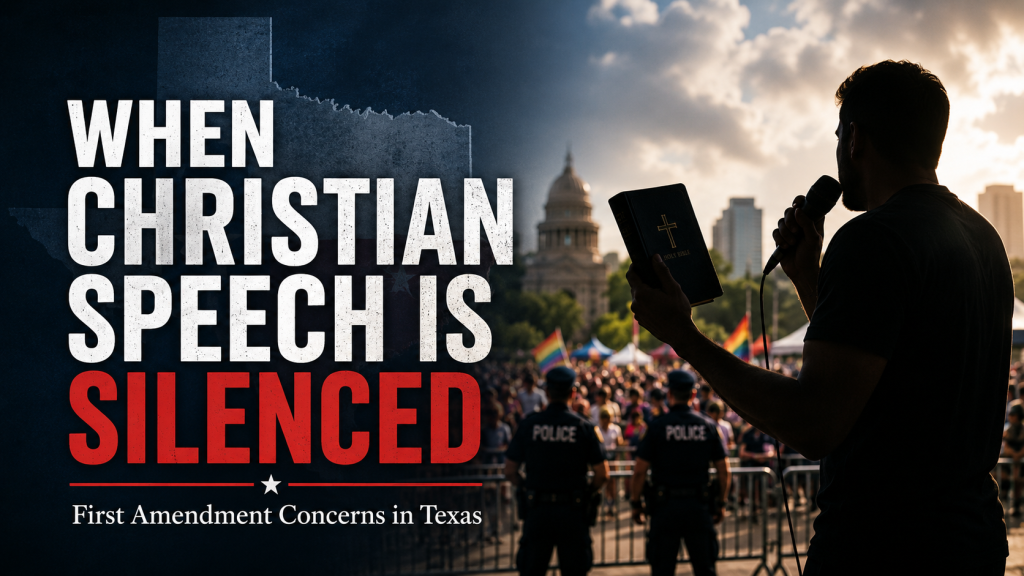
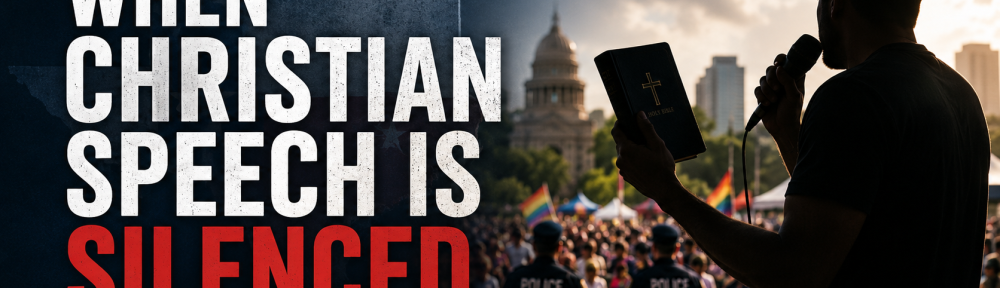
Recent incidents involving Christian preachers and evangelists at LGBTQ Pride events raise serious questions about whether some law-enforcement officers understand that principle. In several cases, Christians speaking, preaching or distributing religious literature in public areas have been threatened with arrest, removed from public spaces, confined to isolated “free speech zones,” cited or actually arrested.
These incidents reveal a troubling and recurring pattern—particularly when similar incidents continue to occur in the same Texas city after lawsuits, settlements and court orders were supposed to clarify the law.
This is not about whether everyone agrees with the message or methods of a particular street preacher. It is about whether government officials will protect the constitutional rights of everyone, even when the message being expressed is unpopular or considered offensive.
Fort Worth, Texas — Trinity Pride Fest, June 2026
The most recent incident occurred on June 27, 2026, during Trinity Pride Fest in Fort Worth.
Christian street preachers David Grisham and Richard Penkoski arrived near the event intending to preach. Video from the encounter showed officers speaking with the preachers about where they could stand and what they could say.
In one recorded exchange, an officer was asked whether police would issue a ticket because someone considered the preaching offensive. The officer answered affirmatively and referred to disorderly conduct. Another officer described certain questions involving allegedly offensive language as a “gray area.”
Grisham was eventually issued a disorderly-conduct citation related to what police described as unreasonable noise from a bullhorn. Fort Worth police said nearby businesses had complained that the amplified sound disrupted their operations. According to the department, officers warned that the preaching could continue without amplification, but the bullhorn was used after the warning and was seized as evidence. [1]
Fort Worth Police Department acknowledged that an officer made statements during the encounter that were “not accurate.” The department announced that current officers and new trainees would receive refresher training on the First Amendment, protesters and free-speech activity. [1]
The head of the U.S. Department of Justice Civil Rights Division publicly described the footage as troubling and said her team was looking at it. As of this writing, that statement should not be described as a formal finding that anyone’s rights were violated. [2]
The distinction is important. The bullhorn citation remains disputed, but a person’s speech cannot lawfully become disorderly conduct merely because someone finds the religious message offensive.
Waco, Texas — Christians Confined to a “Free Speech Zone”
In October 2024, Pastor Ronnie Holmes and members of his church went to the “Out on the Brazos” Pride event at Brazos Park East, a city-owned public park in Waco.
According to Holmes and First Liberty Institute, members of the group were having religious conversations with event attendees when three Waco police officers stopped them and escorted them to a designated “free speech zone.” The area was reportedly approximately 10 feet by 20 feet and located about half a football field away from the primary event area.
The restriction was particularly concerning because the remainder of the public park reportedly remained open to the public during the event.
First Liberty later warned the city that isolating religious speakers in a distant area could violate their rights to free speech and the free exercise of religion. In July 2025, it was announced that Waco would allow members of the church to engage in religious conversations outside the designated speech zone at future events. [3]
No court entered a final judgment against Waco, and the incident did not involve a documented arrest. Nevertheless, the city’s change in position was significant.
A public-event permit does not ordinarily transform an entire public park into private property or give event organizers authority to exclude every opposing viewpoint from areas that remain open to the public.
Fort Worth, Texas — Street Preacher Arrested Outside Pride Event in 2022
The 2026 confrontation was not Fort Worth’s first dispute involving Christian preaching.
In 2022, Christian street preacher Michael Cody Torres was arrested after an encounter with Fort Worth police outside an LGBTQ Pride event. Torres claimed officers prohibited him from using sound amplification and then arrested him as he attempted to preach.
Torres filed a federal civil-rights lawsuit in January 2023. The case ended in a settlement and payment to Torres rather than a trial determining all the disputed facts.
A later federal-court opinion discussing Fort Worth’s history with Torres described the 2022 encounter—as alleged by Torres—as arguably the most problematic of the previous incidents. The court noted that the prohibition appeared to be a complete ban on amplification and that it resulted in a settlement and payment. [4]
The distinction between reasonable volume limits and a total ban is important. A city may enforce a neutral noise ordinance. It cannot selectively prohibit amplification because officials or listeners disapprove of the speaker’s message.
Fort Worth, Texas — Arrest Threats and a Federal Consent Decree in 2014
The history goes back even further.
In 2014, David Grisham—the same evangelist involved in the 2026 Trinity Pride Fest encounter—and members of his family went to the Tarrant County Gay Pride Week Association Festival in downtown Fort Worth.
The festival was free, open to the public and conducted in a public square. Grisham’s wife and daughter distributed Gospel tracts.
According to the federal-court record, Fort Worth police told Grisham’s wife and daughter, under threat of arrest, that they had to leave the park. Officers escorted them across the street. When Grisham objected, an officer issued a trespass warning and told him he would be arrested if he returned to the square or adjoining sidewalk. [5]
Grisham sued the city.
The case resulted in a federal consent decree—a settlement approved and entered as an enforceable court order. Fort Worth agreed that it would:
- Allow constitutionally protected expression on public sidewalks and streets during events that are free and open to the public.
- Notify event permit holders that other speakers may exercise their constitutional rights.
- Refrain from unlawfully banning or interfering with third-party speakers during public events.
The decree preserved the city’s authority to enforce lawful time, place and manner restrictions. It did not give anyone permission to obstruct an event, threaten attendees or violate neutral safety rules. [5]
The most troubling part of the 2026 incident is therefore not simply that questions arose about a bullhorn. It is that Fort Worth had already faced litigation involving the same evangelist, at another Pride event, and had entered a federal court order intended to prevent similar First Amendment problems.
Similar Incidents Outside Texas
The concern is not limited to Texas.
Reading, Pennsylvania
In June 2023, Damon Atkins was arrested for disorderly conduct after beginning to speak across the street from a Pride event in Reading, Pennsylvania. The local district attorney later withdrew the criminal charge after reviewing video of the incident and applicable law.
Seattle, Washington
Christian evangelist Matthew Meinecke was arrested at a Seattle Pride event in 2022 after attendees reportedly surrounded, harassed and physically confronted him while he attempted to read from the Bible.
Police directed Meinecke to move instead of removing those interfering with him. When he refused to relocate, officers arrested him for obstruction.
In 2024, the U.S. Court of Appeals for the Ninth Circuit ruled in Meinecke’s favor at the preliminary-injunction stage. The court concluded that police may not silence a lawful speaker simply because hostile listeners react badly to the speech. The appellate court ordered that an injunction be entered protecting Meinecke from similar enforcement. [7]
What the First Amendment Protects—and What It Does Not
Public parks, streets and sidewalks have traditionally received the strongest First Amendment protections. Government may not restrict a person’s speech in these places merely because officials or listeners disagree with the viewpoint being expressed.
That protection belongs to everyone:
- Pride organizers and attendees.
- Christian preachers and evangelists.
- Political demonstrators.
- Supporters and opponents of government policy.
- People expressing liberal, conservative, religious or secular viewpoints.
Government may still enforce reasonable rules concerning traffic, actual obstruction, violence, unlawful threats, access to buildings, excessive noise and other conduct. These are commonly called time, place and manner restrictions.
Those restrictions must be based on legitimate public-safety or operational concerns—not the popularity, offensiveness or religious content of the speaker’s message. [8]
Speech does not lose its constitutional protection simply because someone complains that it is offensive.
Why This Matters to Seguin
As Seguin considers controversial public events, city officials and law enforcement must be prepared to protect the constitutional rights of everyone involved.
That means protecting event attendees from violence, threats and unlawful disruption. It also means protecting peaceful protesters, Christian preachers and other speakers who remain in lawful public areas.
Before a major public event, the city should have:
- Clearly identified public and restricted areas.
- Officers trained on public-forum and First Amendment law.
- A plan for addressing actual misconduct without silencing lawful speakers.
- Supervisors available to correct unconstitutional instructions before an unnecessary arrest or citation occurs.
The standard cannot be whether someone is offended. The standard must be whether the speaker is violating a lawful, constitutional and viewpoint-neutral rule.
Constitutional Rights Must Apply Equally
Christians should not have to surrender their constitutional rights when entering a public area near a Pride event. Pride participants should not have to surrender theirs when Christians organize a public gathering.
The answer is not selective enforcement. The answer is equal enforcement.
We do not have to approve of every message to defend the speaker’s constitutional rights. In fact, the true test of our commitment to free speech comes when the message is one we strongly oppose.
Once government officials are permitted to decide that one viewpoint is too offensive to be heard, the First Amendment no longer protects any of us reliably.
References
1. Fort Worth Star-Telegram, “Fort Worth police receiving free speech refresher after street preacher incident,” July 2, 2026; Fort Worth Police Department statement regarding the June 27 Trinity Pride Fest encounter.
2. Dallas Express, “Fort Worth Pride Fest Police Video Lands on DOJ Civil Rights Chief’s Radar,” July 11, 2026.
3. KWTX, “Waco church group will be free to engage in religious dialogue at Brazos River East,” July 9, 2025; First Liberty Institute announcement concerning Pastor Ronnie Holmes.
4. Torres v. City of Fort Worth, federal settlement referenced in Torres v. Fort Worth, U.S. District Court for the Northern District of Texas, February 27, 2026; WFAA coverage of the original Pride-event arrest and lawsuit.
5. Grisham v. City of Fort Worth, U.S. Court of Appeals for the Fifth Circuit, September 19, 2016.
6. Atkins v. City of Reading, U.S. District Court for the Eastern District of Pennsylvania, July 29, 2024.
7. Meinecke v. City of Seattle, U.S. Court of Appeals for the Ninth Circuit, April 18, 2024.
8. Library of Congress, Constitution Annotated, “The Public Forum.”
This article discusses general constitutional principles and reported legal cases. It is not legal advice.