Leviticus, Holiness, and the Christian Response to Pride Month

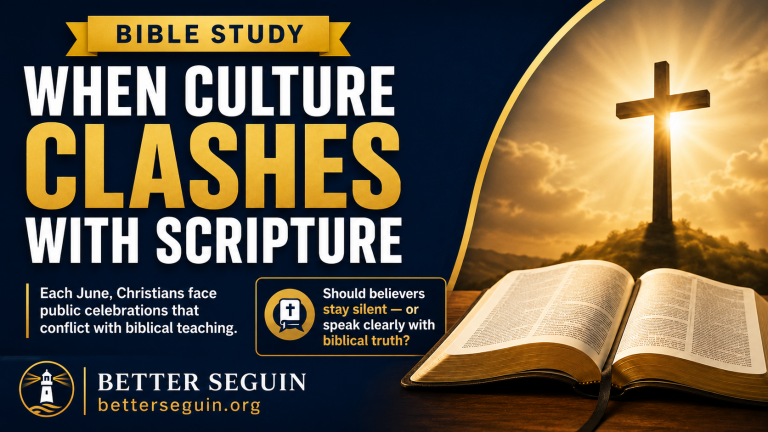
Bible study graphic titled “When Culture Clashes with Scripture,” featuring an open Bible and a cross illuminated by sunlight.

Each June, Christians are confronted with public celebrations of beliefs and behaviors that conflict with biblical teaching. How should believers respond? Should we remain silent to avoid controversy, or should we speak clearly about what Scripture says?

The book of Leviticus helps answer these questions. Although written thousands of years ago, its central message remains relevant: God is holy, and He calls His people to live differently from the culture around them.

Why Was Leviticus Written?

God gave the book of Leviticus to Israel after delivering the nation from slavery in Egypt. For generations, the Israelites had lived among pagan worship, idolatry, and immoral practices. They were also preparing to enter Canaan, where they would encounter cultures that rejected God’s standards.

God warned them:

“You must not do as they do in Egypt, where you used to live, and you must not do as they do in the land of Canaan.”
—Leviticus 18:3, NIV

Israel was not supposed to determine right and wrong by observing surrounding cultures. God’s Word—not popular opinion—was to guide their worship, relationships, families, and conduct.

That principle still applies. Christians should not allow culture, politics, entertainment, or social pressure to redefine what God has already revealed.

The Central Message: Be Holy

Leviticus is sometimes viewed as a difficult collection of sacrifices, ceremonies, dietary rules, and regulations. Yet its central theme is simple:

“Be holy because I, the Lord your God, am holy.”
—Leviticus 19:2, NIV

Holiness means being set apart for God. It does not mean Christians are morally superior or without sin. It means believers belong to God and should seek to reflect His character.

Biblical holiness affects every part of life, including honesty, worship, compassion, marriage, family, and sexual behavior. God does not invite us to obey only the commands that are comfortable or culturally acceptable.

What Does Leviticus Say About Sexual Conduct?

Leviticus 18 addresses several forms of sexual behavior that God prohibited. These commands protected marriage, family relationships, children, and the moral integrity of the community.

Concerning same-sex sexual conduct, Scripture says:

“Do not have sexual relations with a man as one does with a woman.”
—Leviticus 18:22, NIV

This teaching did not originate with modern politics, a political party, or a particular denomination. It appears within Scripture’s broader teaching that God designed sexual intimacy for the marriage covenant between a man and a woman.

Jesus pointed back to that creation design when He said:

“At the beginning the Creator ‘made them male and female.’”
—Matthew 19:4, NIV

Jesus then described marriage as the union of a man and a woman who become “one flesh” under God.

Christians therefore cannot honestly claim that the Bible is silent about homosexuality or that biblical marriage can be redefined according to changing cultural preferences.

Does the Old Testament Still Apply?

A common objection is that Christians do not follow every command in Leviticus. Christians eat foods that Israel was forbidden to eat, wear clothing made from mixed fabrics, and do not participate in the Old Testament sacrificial system.

That observation is true, but it does not settle the question.

Christians read Leviticus through the new covenant established by Jesus Christ. The sacrifices, priesthood, purification rituals, and ceremonial regulations pointed forward to Christ and were fulfilled through His life, death, and resurrection.

However, the New Testament repeatedly reaffirms the moral teachings regarding sexual conduct.

Romans 1 describes same-sex sexual behavior as contrary to God’s created order. First Corinthians 6 includes sexual immorality and homosexual practice among sins from which people must turn. First Timothy 1 also identifies sexual behavior outside God’s design as contrary to sound doctrine.

The New Testament does not command the Church to enforce the civil punishments given specifically to ancient Israel. Christians are not instructed to stone adulterers, homosexuals, or anyone else. The Church’s mission is to proclaim the gospel, call people to repentance, make disciples, and offer restoration through Christ.

The ancient civil penalty is not transferred to the Church, but the underlying moral teaching is repeated and remains relevant.

Truth and Grace Must Remain Together

Christians must avoid two opposite errors.

The first is abandoning biblical truth in an effort to appear loving. Love does not require us to call something good when God calls it sinful. A doctor does not demonstrate compassion by refusing to identify a dangerous condition. In the same way, Christians should not hide biblical teaching simply because it is unpopular.

The second error is speaking truth without humility, compassion, or grace. People who experience same-sex attraction are created in the image of God and should never be mocked, threatened, or treated as less valuable than anyone else.

Every person has sinned. Sexual sin is not the only sin addressed in Scripture, nor is it the only sin that separates people from God. Pride, greed, adultery, dishonesty, hatred, drunkenness, and many other sins also require repentance.

Paul reminded the Corinthian believers that some of them had previously lived in serious sin, but their lives had been changed:

“But you were washed, you were sanctified, you were justified in the name of the Lord Jesus Christ.”
—1 Corinthians 6:11, NIV

That is the hope of the gospel. Christianity does not teach that some people are beyond redemption. It teaches that all people need forgiveness and that Christ can transform anyone who turns to Him in repentance and faith.

How Should Christians Respond During Pride Month?

Pride Month places enormous cultural pressure on Christians to celebrate ideas that conflict with biblical teaching. Some believers respond with silence. Others respond with anger. Scripture gives us a better path.

We should speak the truth in love. We should refuse to compromise what God has said while also refusing to treat people with cruelty or contempt.

Christians should:

  • Know what Scripture teaches rather than relying on slogans or social media.
  • Explain biblical truth calmly and accurately.
  • Treat every person with dignity and respect.
  • Protect children from sexually inappropriate content and ideological pressure.
  • Support God’s design for marriage and family.
  • Pray for those who disagree with us.
  • Be willing to examine and repent of our own sins.
  • Share the forgiveness and new life available through Jesus Christ.

Faithfulness does not require hostility, but it does require courage.

A Word to Churches and Christian Leaders

Pastors, teachers, parents, and Christian public officials must not avoid difficult subjects simply because they may create controversy. Silence can leave believers confused and allow false teaching to spread unchallenged.

Christian leaders should clearly explain the difference between loving a person and affirming every belief or behavior. Jesus welcomed sinners, ate with sinners, and showed them compassion. Yet He also called people to repentance and told them to leave their lives of sin.

The Church must follow His example. Grace without truth becomes permission. Truth without grace becomes harshness. Jesus embodied both.

Questions for Reflection

  1. Am I allowing Scripture or culture to define my beliefs about sexuality and marriage?
  2. Can I explain why some Old Testament commands were fulfilled in Christ while moral teachings remain applicable?
  3. Do I speak biblical truth with courage, humility, and compassion?
  4. Am I more concerned about winning arguments or helping people know Christ?
  5. Are there sins in my own life that I need to confess and turn away from?

Closing

Leviticus reminds us that God’s people are called to be different. Holiness has never been determined by public opinion, political power, or cultural popularity. It is determined by the character and Word of God.

Christians should not be ashamed of biblical teaching about marriage and sexuality. At the same time, we must remember that our message is not merely a declaration that sin is wrong. It is the good news that forgiveness, cleansing, and transformation are available through Jesus Christ.

Our calling is to stand firmly on God’s truth, love people sincerely, protect what is good, and faithfully point others toward the Savior.

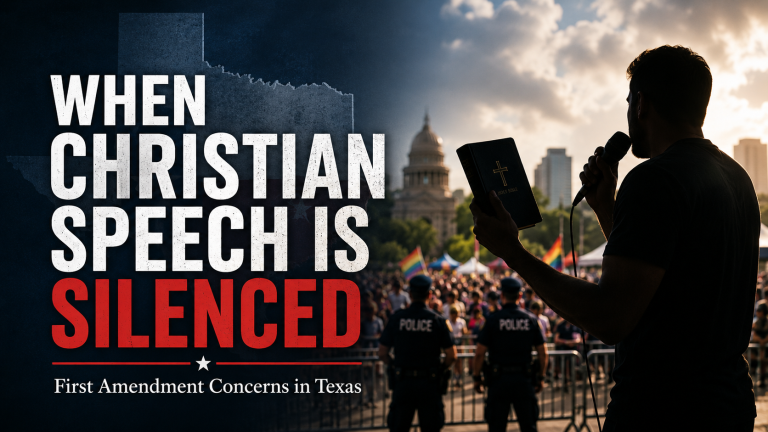
When Christian Speech Is Silenced

When Christian Speech Is Treated as the Problem: A Growing First Amendment Concern

The First Amendment does not protect only popular speech, government-approved speech or speech that makes everyone comfortable. Its greatest value is protecting speech that others may strongly oppose.

Recent incidents involving Christian preachers and evangelists at LGBTQ Pride events raise serious questions about whether some law-enforcement officers understand that principle. In several cases, Christians speaking, preaching or distributing religious literature in public areas have been threatened with arrest, removed from public spaces, confined to isolated “free speech zones,” cited or actually arrested.

These incidents reveal a troubling and recurring pattern—particularly when similar incidents continue to occur in the same Texas city after lawsuits, settlements and court orders were supposed to clarify the law.

This is not about whether everyone agrees with the message or methods of a particular street preacher. It is about whether government officials will protect the constitutional rights of everyone, even when the message being expressed is unpopular or considered offensive.

Fort Worth, Texas — Trinity Pride Fest, June 2026

The most recent incident occurred on June 27, 2026, during Trinity Pride Fest in Fort Worth.

Christian street preachers David Grisham and Richard Penkoski arrived near the event intending to preach. Video from the encounter showed officers speaking with the preachers about where they could stand and what they could say.

In one recorded exchange, an officer was asked whether police would issue a ticket because someone considered the preaching offensive. The officer answered affirmatively and referred to disorderly conduct. Another officer described certain questions involving allegedly offensive language as a “gray area.”

Grisham was eventually issued a disorderly-conduct citation related to what police described as unreasonable noise from a bullhorn. Fort Worth police said nearby businesses had complained that the amplified sound disrupted their operations. According to the department, officers warned that the preaching could continue without amplification, but the bullhorn was used after the warning and was seized as evidence. [1]

Fort Worth Police Department acknowledged that an officer made statements during the encounter that were “not accurate.” The department announced that current officers and new trainees would receive refresher training on the First Amendment, protesters and free-speech activity. [1]

The head of the U.S. Department of Justice Civil Rights Division publicly described the footage as troubling and said her team was looking at it. As of this writing, that statement should not be described as a formal finding that anyone’s rights were violated. [2]

The distinction is important. The bullhorn citation remains disputed, but a person’s speech cannot lawfully become disorderly conduct merely because someone finds the religious message offensive.

Waco, Texas — Christians Confined to a “Free Speech Zone”

In October 2024, Pastor Ronnie Holmes and members of his church went to the “Out on the Brazos” Pride event at Brazos Park East, a city-owned public park in Waco.

According to Holmes and First Liberty Institute, members of the group were having religious conversations with event attendees when three Waco police officers stopped them and escorted them to a designated “free speech zone.” The area was reportedly approximately 10 feet by 20 feet and located about half a football field away from the primary event area.

The restriction was particularly concerning because the remainder of the public park reportedly remained open to the public during the event.

First Liberty later warned the city that isolating religious speakers in a distant area could violate their rights to free speech and the free exercise of religion. In July 2025, it was announced that Waco would allow members of the church to engage in religious conversations outside the designated speech zone at future events. [3]

No court entered a final judgment against Waco, and the incident did not involve a documented arrest. Nevertheless, the city’s change in position was significant.

A public-event permit does not ordinarily transform an entire public park into private property or give event organizers authority to exclude every opposing viewpoint from areas that remain open to the public.

Fort Worth, Texas — Street Preacher Arrested Outside Pride Event in 2022

The 2026 confrontation was not Fort Worth’s first dispute involving Christian preaching.

In 2022, Christian street preacher Michael Cody Torres was arrested after an encounter with Fort Worth police outside an LGBTQ Pride event. Torres claimed officers prohibited him from using sound amplification and then arrested him as he attempted to preach.

Torres filed a federal civil-rights lawsuit in January 2023. The case ended in a settlement and payment to Torres rather than a trial determining all the disputed facts.

A later federal-court opinion discussing Fort Worth’s history with Torres described the 2022 encounter—as alleged by Torres—as arguably the most problematic of the previous incidents. The court noted that the prohibition appeared to be a complete ban on amplification and that it resulted in a settlement and payment. [4]

The distinction between reasonable volume limits and a total ban is important. A city may enforce a neutral noise ordinance. It cannot selectively prohibit amplification because officials or listeners disapprove of the speaker’s message.

Fort Worth, Texas — Arrest Threats and a Federal Consent Decree in 2014

The history goes back even further.

In 2014, David Grisham—the same evangelist involved in the 2026 Trinity Pride Fest encounter—and members of his family went to the Tarrant County Gay Pride Week Association Festival in downtown Fort Worth.

The festival was free, open to the public and conducted in a public square. Grisham’s wife and daughter distributed Gospel tracts.

According to the federal-court record, Fort Worth police told Grisham’s wife and daughter, under threat of arrest, that they had to leave the park. Officers escorted them across the street. When Grisham objected, an officer issued a trespass warning and told him he would be arrested if he returned to the square or adjoining sidewalk. [5]

Grisham sued the city.

The case resulted in a federal consent decree—a settlement approved and entered as an enforceable court order. Fort Worth agreed that it would:

  • Allow constitutionally protected expression on public sidewalks and streets during events that are free and open to the public.
  • Notify event permit holders that other speakers may exercise their constitutional rights.
  • Refrain from unlawfully banning or interfering with third-party speakers during public events.

The decree preserved the city’s authority to enforce lawful time, place and manner restrictions. It did not give anyone permission to obstruct an event, threaten attendees or violate neutral safety rules. [5]

The most troubling part of the 2026 incident is therefore not simply that questions arose about a bullhorn. It is that Fort Worth had already faced litigation involving the same evangelist, at another Pride event, and had entered a federal court order intended to prevent similar First Amendment problems.

Similar Incidents Outside Texas

The concern is not limited to Texas.

Reading, Pennsylvania

In June 2023, Damon Atkins was arrested for disorderly conduct after beginning to speak across the street from a Pride event in Reading, Pennsylvania. The local district attorney later withdrew the criminal charge after reviewing video of the incident and applicable law.

Seattle, Washington

Christian evangelist Matthew Meinecke was arrested at a Seattle Pride event in 2022 after attendees reportedly surrounded, harassed and physically confronted him while he attempted to read from the Bible.

Police directed Meinecke to move instead of removing those interfering with him. When he refused to relocate, officers arrested him for obstruction.

In 2024, the U.S. Court of Appeals for the Ninth Circuit ruled in Meinecke’s favor at the preliminary-injunction stage. The court concluded that police may not silence a lawful speaker simply because hostile listeners react badly to the speech. The appellate court ordered that an injunction be entered protecting Meinecke from similar enforcement. [7]

What the First Amendment Protects—and What It Does Not

Public parks, streets and sidewalks have traditionally received the strongest First Amendment protections. Government may not restrict a person’s speech in these places merely because officials or listeners disagree with the viewpoint being expressed.

That protection belongs to everyone:

  • Pride organizers and attendees.
  • Christian preachers and evangelists.
  • Political demonstrators.
  • Supporters and opponents of government policy.
  • People expressing liberal, conservative, religious or secular viewpoints.

Government may still enforce reasonable rules concerning traffic, actual obstruction, violence, unlawful threats, access to buildings, excessive noise and other conduct. These are commonly called time, place and manner restrictions.

Those restrictions must be based on legitimate public-safety or operational concerns—not the popularity, offensiveness or religious content of the speaker’s message. [8]

Speech does not lose its constitutional protection simply because someone complains that it is offensive.

Why This Matters to Seguin

As Seguin considers controversial public events, city officials and law enforcement must be prepared to protect the constitutional rights of everyone involved.

That means protecting event attendees from violence, threats and unlawful disruption. It also means protecting peaceful protesters, Christian preachers and other speakers who remain in lawful public areas.

Before a major public event, the city should have:

  • Clearly identified public and restricted areas.
  • Officers trained on public-forum and First Amendment law.
  • A plan for addressing actual misconduct without silencing lawful speakers.
  • Supervisors available to correct unconstitutional instructions before an unnecessary arrest or citation occurs.

The standard cannot be whether someone is offended. The standard must be whether the speaker is violating a lawful, constitutional and viewpoint-neutral rule.

Constitutional Rights Must Apply Equally

Christians should not have to surrender their constitutional rights when entering a public area near a Pride event. Pride participants should not have to surrender theirs when Christians organize a public gathering.

The answer is not selective enforcement. The answer is equal enforcement.

We do not have to approve of every message to defend the speaker’s constitutional rights. In fact, the true test of our commitment to free speech comes when the message is one we strongly oppose.

Once government officials are permitted to decide that one viewpoint is too offensive to be heard, the First Amendment no longer protects any of us reliably.


References

1. Fort Worth Star-Telegram, “Fort Worth police receiving free speech refresher after street preacher incident,” July 2, 2026; Fort Worth Police Department statement regarding the June 27 Trinity Pride Fest encounter.

2. Dallas Express, “Fort Worth Pride Fest Police Video Lands on DOJ Civil Rights Chief’s Radar,” July 11, 2026.

3. KWTX, “Waco church group will be free to engage in religious dialogue at Brazos River East,” July 9, 2025; First Liberty Institute announcement concerning Pastor Ronnie Holmes.

4. Torres v. City of Fort Worth, federal settlement referenced in Torres v. Fort Worth, U.S. District Court for the Northern District of Texas, February 27, 2026; WFAA coverage of the original Pride-event arrest and lawsuit.

5. Grisham v. City of Fort Worth, U.S. Court of Appeals for the Fifth Circuit, September 19, 2016.

6. Atkins v. City of Reading, U.S. District Court for the Eastern District of Pennsylvania, July 29, 2024.

7. Meinecke v. City of Seattle, U.S. Court of Appeals for the Ninth Circuit, April 18, 2024.

8. Library of Congress, Constitution Annotated, “The Public Forum.”

This article discusses general constitutional principles and reported legal cases. It is not legal advice.

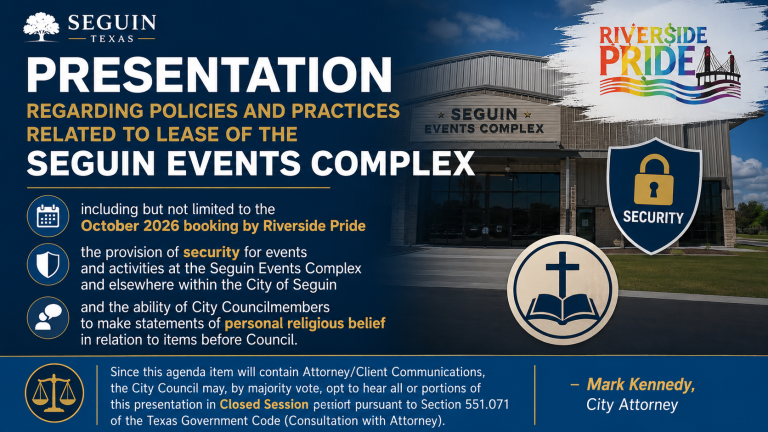
Presentation regarding policies and practices related to lease of the Seguin Events Complex

Presentation regarding policies and practices related to lease of the Seguin Events Complex, including but not limited to the October 2026 booking by Riverside Pride, the provision of security for events and activities at the Seguin Events Complex and elsewhere within the City of Seguin, and the ability of City Councilmembers to make statements of personal religious belief in relation to items before Council.

June 16, 2026 Seguin Council Meeting

Presentation regarding policies and practices related to lease of the Seguin Events Complex, including but not limited to the October 2026 booking by Riverside Pride, the provision of security for events and activities at the Seguin Events Complex and elsewhere within the City of Seguin, and the ability of City Councilmembers to make statements of personal religious belief in relation to items before Council. Since this agenda item will contain Attorney/Client Communications, the City Council may, by majority vote, opt to hear all or portions of this presentation in Closed Session, pursuant to Section 551.071 of the Texas Government Code (Consultation with Attorney). – Mark Kennedy, City Attorney

James Parker, Pastor of One Hope Church, spoke in opposition to the Riverside Pride event. He stated that Christians should base their beliefs and actions on what he described as the unchanging truth of God’s Word rather than cultural acceptance. He expressed concern that some churches and pastors are affirming conduct that he believes the Bible identifies as sinful, arguing that their role should instead be to preach repentance and the Gospel. Pastor Parker stated that the issue extends beyond whether individuals choose to attend the event, asserting that publicly celebrating values he believes conflict with biblical teachings has broader implications for the community. He stated that his opposition was rooted in his religious convictions that God created male and female, that marriage is between one man and one woman, and that love and truth are not enemies. He urged the City Council to base its decision on biblical principles rather than societal or cultural pressures. Joseph Brown, a member of One Hope Church, presented a petition containing approximately 100 signatures from individuals opposing the Riverside Pride event. He stated that he believes the event celebrates sexual behavior and promotes a definition of love that is based on individual preference rather than moral or religious principles. Mr. Brown discussed his interpretation of the constitutional principle of separation of church and state, stating that it was intended to prevent government interference with religion rather than remove religious principles from government. He further expressed his belief that strong families are foundational to healthy communities and voiced concerns that the event promotes values inconsistent with his religious convictions.

City Attorney Mark Kennedy stated that he was asked 3 things; why does events that are objectionable happen; how does the City address added security needs and who bares the cost of those needs; and what are the implications of a councilmember expressing their religious beliefs. He said that typically these types of explanations are done in Closed Session and are protected under Attorney-Client privilege. City Council gave consensus to continue the discussion in Open Session and to waive their Attorney-Client privilege. City Attorney Kennedy explained the difference between the Non-Public Forum, Limited Public Forum, Designated Public Form, Traditional Public Form because each one is awarded different 1st Amendment protection. He explained that any regulation should be content neutral, not based on the content of speakers words, unless it incites violence or violates he law. He also shared that assumptions being made about SB12 may not be correct. He informed that the coordinators of the event have indicated that SB12 would not be violated. Mr. Kennedy reviewed the provisions of Senate Bill 12, enacted in 2023, which amended the Texas Health and Safety Code, Penal Code, and Local Government Code. He explained that the law prohibits sexually oriented performances on public property, defining such performances as those involving nudity or sexual conduct intended to appeal to a prurient interest in sex. He stated that a drag performance is not automatically considered a sexually oriented performance under the law and provided examples of performances involving cross-dressing, such as Shakespearean productions and school pep rally skits, that would not violate the statute. He further noted that the event organizers had indicated that the event would be limited to individuals 18 years of age and older; however, regardless of the audience, any performance conducted on public property must comply with the requirements of Senate Bill 12. Addressing security, Mr. Kennedy explained that the City has historically provided law enforcement support for spontaneous First Amendment activities, such as the George Floyd protests and the No Kings rally, without charging organizers because those events did not require reservations for the use of public space. He stated that this practice is consistent with the City’s historical approach to First Amendment activities. Regarding the Riverside Pride event, he stated that organizers had indicated they would hire and pay for private security personnel. He further explained that, under normal procedures, the City would assign additional law enforcement officers as necessary to maintain public safety and separate opposing groups if protests occurred. He also discussed the concept of the “heckler’s veto,” explaining that government generally may not restrict or terminate protected speech because of the anticipated reaction of those who oppose the event. Mr. Kennedy also addressed questions concerning councilmembers expressing their religious beliefs during Council meetings. He stated that elected officials inevitably bring their personal beliefs and values into public service; however, they also take an oath to uphold the Constitution and the laws of the United States and the State of Texas. He explained that comments made during Council meetings should generally be germane to the posted agenda item, while councilmembers remain free to express personal opinions in other appropriate forums, including social media. He advised that when the law clearly governs an issue, councilmembers must consider their legal obligations when voting, regardless of personal beliefs. Mr. Kennedy further explained that there was no action currently before the Council because the facility lease agreement had been executed administratively in the normal course of business and did not require City Council approval. Councilmember Carlsson stated that he appreciated hearing from the members of the public who had spoken and asked whether the lease agreement would come before the Council for a vote. Mr. Kennedy responded that the agreement had been execute Councilmember Gaytan asked whether the matter could nonetheless be brought before the City Council for consideration. Mr. Kennedy replied that the lease had already been executed and that any future Council action would involve consideration of terminating the agreement. Councilmember Gaytan then asked what legal grounds would exist to reverse the decision. Mr. Kennedy responded that if evidence demonstrated a violation of Senate Bill 12 or another applicable law, staff would notify the City Manager and the matter could be brought forward for appropriate consideration. He added that, based on the information currently available, he had not heard any facts indicating that such a violation had occurred. Councilmember Lievens thanked everyone who participated in the meeting and expressed appreciation for those who took the time to publicly share their views during a difficult and controversial discussion. Councilmember Eveld stated that statements regarding religious beliefs had been made several times during the discussion. He emphasized that while his personal religious convictions are important to him, they do not authorize him to violate the law or disregard the terms of a valid lease agreement. He referenced comments made by a member of the public describing the issue as a spiritual matter and shared his concerns regarding messages that he believes could affect young people struggling with gender identity. Councilmember Eveld stated that, while the religious issues involved are significant to him personally, he remains obligated to follow the law in carrying out his duties as an elected official.

Representative Alan Schoolcraft on opposition to PrideFest


Posted on the Representatives X account. We need more strong willed elected officials to follow suit.

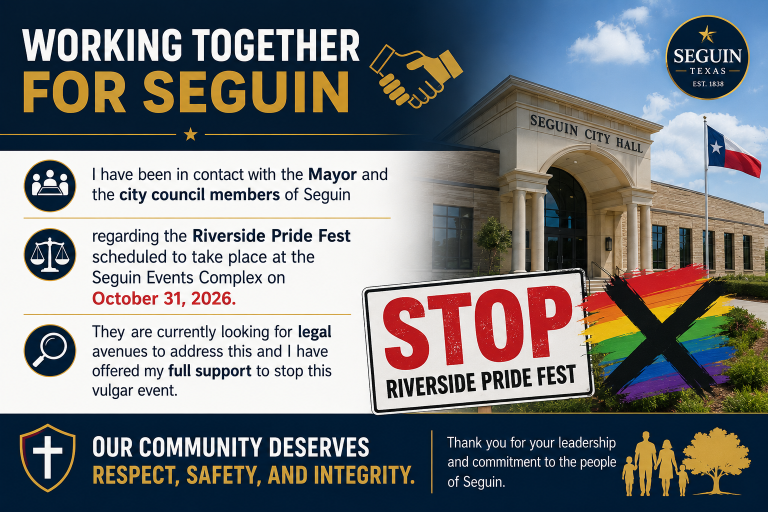
I have been in contact with the Mayor and the city council members of Seguin regarding the Riverside Pride Fest scheduled to take place at the Seguin Events Complex on October 31, 2026. They are currently looking for legal avenues to address this and I have offered my full support to stop this vulgar event

Link to post: https://x.com/Schoolcraft4TX/status/2057162528145465535

Rep. Alan Schoolcraft

@Schoolcraft4TX

I have been in contact with the Mayor and the city council members of Seguin regarding the Riverside Pride Fest scheduled to take place at the Seguin Events Complex on October 31, 2026. They are currently looking for legal avenues to address this and I have offered my full support to stop this vulgar event.

6:12 PM · May 20, 2026147Views