Seguin Electric Rate Increase Raises Questions About Cost Assumptions
Written by Better Seguin: Aug 2026
The Seguin City Council has approved the first reading of an ordinance that would increase electric base rates by approximately 2% per year over the next five years.
The proposed rate plan was recommended by SEnergy, the consulting firm that has worked with the City of Seguin for more than a decade on electric utility rate studies. According to the presentation to City Council, the increases are intended to keep electric revenues aligned with the growing cost of operating the system while supporting continued growth throughout the community.
For the average residential customer using approximately 1,000 kilowatt-hours per month, the estimated bill would increase from about $116.48 to $118.71 during the first year. By the end of the five-year period, the projected monthly bill would be approximately $123.45.
On its face, the proposed increase appears relatively modest. However, some of the financial assumptions being used to justify the rate increases deserve a closer look.

Salary Costs Projected to Rise 5% Annually
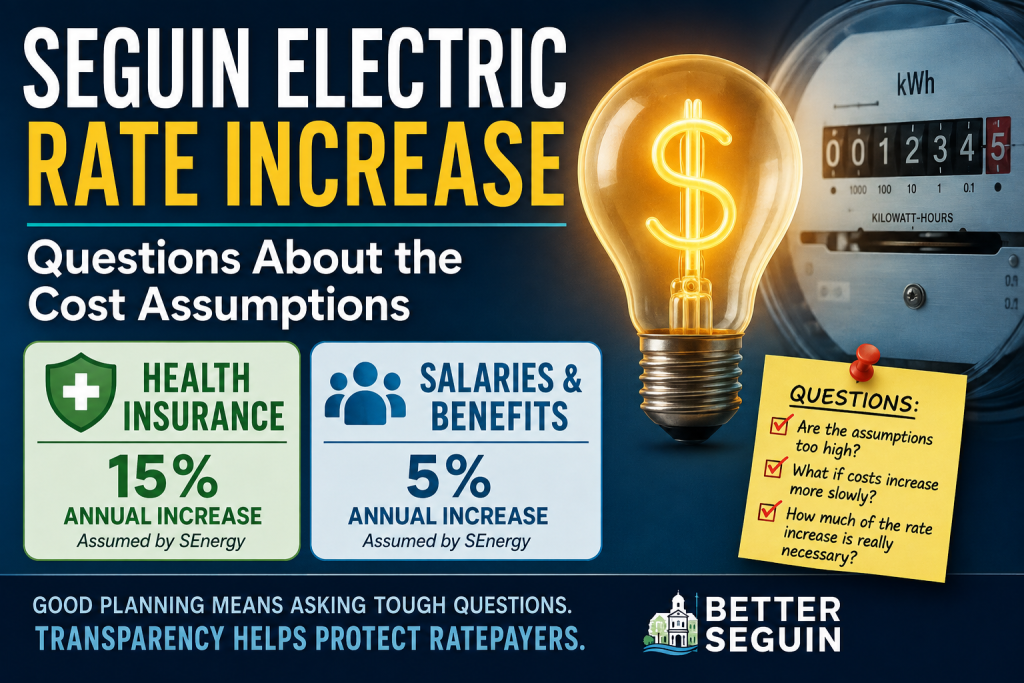
During the presentation, SEnergy reported that salaries and benefits are projected to increase approximately 5% annually.
It is important to understand that this does not necessarily mean City of Seguin employees will receive 5% raises every year. Salary and benefit costs can also increase because of merit increases, step increases, promotions, new positions, market adjustments and other personnel expenses.
Historically, however, Seguin’s cost-of-living adjustments have generally been below 5%.
Recent City budgets have included COLAs of approximately 2% to 3% in many years, although the City did provide a 5% adjustment in 2023 during a period of unusually high inflation.
Nearby local governments have also generally approved employee adjustments closer to the 2% to 3% range in recent budgets.
That raises a reasonable question: If Seguin’s electric-rate forecast assumes salary and benefit costs will increase 5% every year for five years, how much of the proposed electric-rate increase is dependent upon that assumption?
A 5% annual increase compounded over five years represents an increase of more than 27%.
Health Insurance Projected to Increase 15% Annually
Perhaps the more significant assumption involves employee health insurance.
SEnergy’s financial forecast reportedly assumes health insurance costs will increase approximately 15% annually.
Health insurance costs have certainly been increasing nationally, and municipalities with self-funded health plans can experience significant increases when claims are unusually high.
However, 15% annually is a substantial assumption.
Seguin’s previous long-term financial forecasts have used health insurance growth assumptions closer to 7.5% annually. National employer health-benefit cost increases have also recently been running closer to the 6% to 7% range.
If health insurance costs actually increased 15% every year for five consecutive years, the City’s health insurance expense would more than double during that period.
That does not mean the City’s projection is wrong. Seguin may have specific claims experience or insurance renewal information supporting the estimate.
But before electric customers are asked to approve five years of rate increases, City Council should understand exactly where that 15% projection comes from.
Questions Council Should Ask
Before final approval, Council should consider asking staff and SEnergy several additional questions.
Is the projected 5% increase in salaries and benefits based on planned employee raises, historical payroll growth, additional employees, or a combination of those factors?
Is the 15% health insurance assumption based on an actual insurance renewal estimate or simply a conservative forecasting assumption?
Most importantly, Council should ask what happens to the proposed electric rates if those assumptions are lower.
For example, what would the five-year electric-rate requirement look like if salary costs increased 3% annually rather than 5%, and health insurance increased 7.5% rather than 15%?
Providing that comparison would allow residents and Councilmembers to better understand whether the proposed rate increases are primarily driven by electric infrastructure needs or by conservative assumptions regarding future personnel expenses.
Seguin’s electric utility has historically maintained competitive rates, and planning ahead for growth is important.
But good financial planning should also include challenging the assumptions behind long-term forecasts.
The ordinance is scheduled to return to the Seguin City Council for further consideration on August 18, 2026.