Seguin Transportation Funding Faces New Challenges — and Project Readiness Will Matter More Than Ever
Seguin’s participation in the Alamo Area Metropolitan Planning Organization has helped fund major road, trail and sidewalk projects. However, rising construction costs and uncertain state and federal funding are changing how future projects will be selected.
The City of Seguin recently received an update on changes taking place within the Alamo Area Metropolitan Planning Organization, commonly known as AAMPO. These changes could have a significant effect on how future transportation projects in Seguin are planned, funded and constructed.
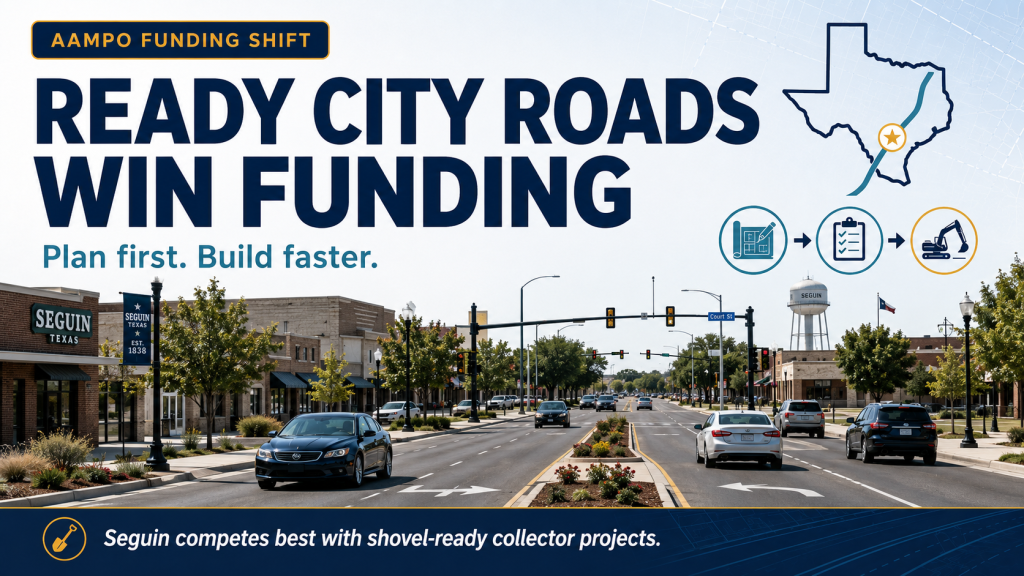
Seguin’s participation in AAMPO has already produced important benefits. However, transportation funding is becoming more competitive, construction costs are rising rapidly, and regional leaders are placing greater emphasis on whether a project is fully planned and ready to begin construction.
The message for Seguin is clear: participation in regional transportation planning remains extremely important, but the City may need to invest more money and effort upfront to keep local projects competitive.
What Is AAMPO?
AAMPO coordinates long-range transportation planning for the San Antonio metropolitan region, which includes Seguin and portions of Guadalupe County.
The organization brings together local governments, counties, TxDOT, public transportation agencies, federal officials and other stakeholders to determine regional transportation priorities. The process is intended to be continuous, cooperative and comprehensive.
AAMPO does not normally build roads itself. Instead, it helps identify needs, prioritize projects and allocate available state and federal transportation funding. The actual work is generally carried out by TxDOT, cities, counties or transportation agencies.
This gives Seguin an important seat at the regional table. Without participation in this process, local projects would have a much more difficult time competing for federal and state transportation dollars.
What Has Seguin Received Through AAMPO Participation?
AAMPO’s Transportation Improvement Program, commonly called the TIP, has helped fund several important Seguin projects.
According to the City’s presentation, TIP funding has contributed to:
- Tor Drive
- Rudeloff Road
- Cordova Road
- Walnut Springs Trail
- District 5 sidewalks
These projects demonstrate the direct value of Seguin’s participation in regional transportation planning.
One current regional priority list also identifies the proposed SH 123 project from Cordova Lane to Interstate 10 as a high-priority project. The project is listed as having environmental clearance and right-of-way completed, with plans reportedly at 100 percent. That level of readiness is exactly what transportation officials are now looking for when deciding which projects should move forward.
Where Does the Transportation Money Come From?
TxDOT’s transportation budget is funded through several major sources.
For the 2026–2027 biennium, the documents show approximately:
- 30 percent from federal funding
- 25 percent from fuel taxes, registration fees and the State Highway Fund
- 20 percent from Proposition 1 oil and gas severance-tax revenue
- 17 percent from Proposition 7 sales and vehicle-sales taxes
- 8 percent from other sources
Each of these funding sources presents challenges.
Federal transportation funding is uncertain as Congress considers the next major transportation authorization. Traditional gasoline and diesel taxes have also lost purchasing power because the tax rate has not been indexed to inflation.
Proposition 1 funding can fluctuate dramatically depending on oil and natural-gas prices. Proposition 7 is more stable, but a large portion of the funding is fixed and does not automatically increase with construction costs.
Construction Costs Are Rising Faster Than Funding
The biggest immediate challenge is inflation.
The presentations report that highway construction costs increased approximately 55 to 60 percent in five years. In practical terms, a road project that cost $100 million several years ago could now cost approximately $160 million.
At the same time, TxDOT’s accumulated cash balance has been depleted, its ten-year construction program has been reduced and approximately $20 billion in projects statewide are being delayed. Funding for new projects, engineering work and right-of-way acquisition is also limited.
This means more Texas communities will be competing for a smaller pool of available money.
Seguin is not only competing against neighboring cities. It is competing against major metropolitan regions with much larger populations, more legislative representation and, in some cases, access to toll-road revenues that can be used as matching funds.
Why AAMPO Is Changing Its Process
Under the traditional process, cities and counties often submitted projects during a call for funding before all the planning, design, environmental work and right-of-way acquisition had been completed.
A project might be placed in the TIP with the expectation that the remaining work would be finished later. When projects were delayed, transportation money could remain committed for years without construction beginning.
According to the presentations, this has contributed to:
- Projects that are not sufficiently prepared
- Limited flexibility in moving money between projects
- Large funding balances being carried over from year to year
- Loss of purchasing power because of inflation
- The possibility that unused funds could be redirected to another region
AAMPO is now considering a more needs-based and planning-driven process.
“Plan Slow, Deliver Fast”
The new approach is being described as “Plan Slow, Deliver Fast.”
That does not mean intentionally delaying projects. It means completing more of the difficult planning work before construction money is committed.
Under this model, a transportation project would move through corridor studies, public input, environmental review, preliminary engineering, right-of-way planning and design before being placed into the short-term funding program.
Only projects that are substantially “shovel ready” would receive major construction commitments.
The goal is to ensure that once money is awarded, the project can move quickly into construction instead of sitting in the funding program for years.
What This Means for Seguin
Seguin will need to maintain a pipeline of well-developed transportation projects.
In many cases, this may require the City to spend more local money upfront for:
- Engineering and design
- Traffic and corridor studies
- Environmental reviews
- Right-of-way planning or acquisition
- Cost estimates
- Public involvement
- Grant applications
Local funding can then be used to leverage much larger state or federal investments.
Transportation officials are also recommending that communities provide a meaningful local match or demonstrate that they have “skin in the game.” Cities with projects that are fully planned, publicly supported and ready to build will be in a much stronger position when unexpected funding becomes available.
The regional strategy also calls for better data, stronger partnerships with TxDOT, coordinated advocacy and creative funding arrangements, including public-private partnerships where appropriate.
Why the Public Should Pay Attention
Transportation planning may appear technical, but the results affect nearly every Seguin resident.
These decisions influence:
- Traffic congestion
- Road safety
- Economic development
- Emergency response times
- Neighborhood access
- Sidewalk and trail construction
- The condition and capacity of major roads
- How quickly Seguin can respond to continued population growth
A road project may take many years to move from an idea to construction. Decisions made today about planning, engineering and project readiness could determine which Seguin projects receive funding five, ten or even twenty years from now.
Seguin has benefited from being part of AAMPO, and continued participation is essential. But simply placing a project on a wish list will no longer be enough.
To remain competitive, Seguin must identify its most important transportation needs, complete the necessary planning and keep projects ready to move when funding opportunities arise.
That preparation will require discipline and, in some cases, an upfront local investment. However, failing to prepare could mean watching limited transportation dollars go to another community that was ready when the opportunity arrived.