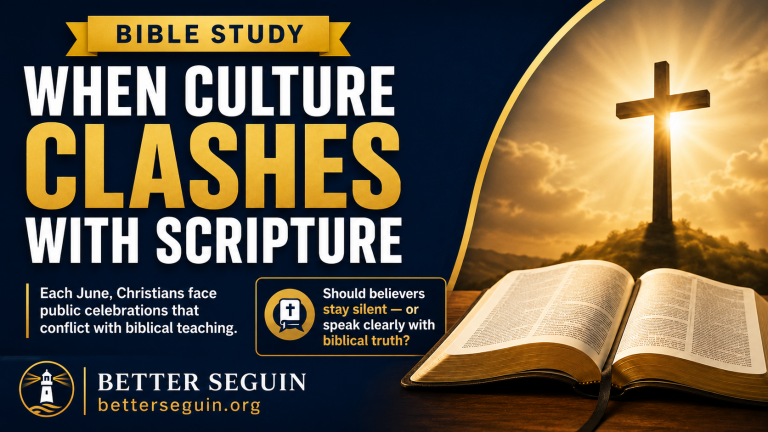
Each June, Christians are confronted with public celebrations of beliefs and behaviors that conflict with biblical teaching. How should believers respond? Should we remain silent to avoid controversy, or should we speak clearly about what Scripture says?
The book of Leviticus helps answer these questions. Although written thousands of years ago, its central message remains relevant: God is holy, and He calls His people to live differently from the culture around them.
Why Was Leviticus Written?
God gave the book of Leviticus to Israel after delivering the nation from slavery in Egypt. For generations, the Israelites had lived among pagan worship, idolatry, and immoral practices. They were also preparing to enter Canaan, where they would encounter cultures that rejected God’s standards.
God warned them:
“You must not do as they do in Egypt, where you used to live, and you must not do as they do in the land of Canaan.”
—Leviticus 18:3, NIV
Israel was not supposed to determine right and wrong by observing surrounding cultures. God’s Word—not popular opinion—was to guide their worship, relationships, families, and conduct.
That principle still applies. Christians should not allow culture, politics, entertainment, or social pressure to redefine what God has already revealed.
The Central Message: Be Holy
Leviticus is sometimes viewed as a difficult collection of sacrifices, ceremonies, dietary rules, and regulations. Yet its central theme is simple:
“Be holy because I, the Lord your God, am holy.”
—Leviticus 19:2, NIV
Holiness means being set apart for God. It does not mean Christians are morally superior or without sin. It means believers belong to God and should seek to reflect His character.
Biblical holiness affects every part of life, including honesty, worship, compassion, marriage, family, and sexual behavior. God does not invite us to obey only the commands that are comfortable or culturally acceptable.
What Does Leviticus Say About Sexual Conduct?
Leviticus 18 addresses several forms of sexual behavior that God prohibited. These commands protected marriage, family relationships, children, and the moral integrity of the community.
Concerning same-sex sexual conduct, Scripture says:
“Do not have sexual relations with a man as one does with a woman.”
—Leviticus 18:22, NIV
This teaching did not originate with modern politics, a political party, or a particular denomination. It appears within Scripture’s broader teaching that God designed sexual intimacy for the marriage covenant between a man and a woman.
Jesus pointed back to that creation design when He said:
“At the beginning the Creator ‘made them male and female.’”
—Matthew 19:4, NIV
Jesus then described marriage as the union of a man and a woman who become “one flesh” under God.
Christians therefore cannot honestly claim that the Bible is silent about homosexuality or that biblical marriage can be redefined according to changing cultural preferences.
Does the Old Testament Still Apply?
A common objection is that Christians do not follow every command in Leviticus. Christians eat foods that Israel was forbidden to eat, wear clothing made from mixed fabrics, and do not participate in the Old Testament sacrificial system.
That observation is true, but it does not settle the question.
Christians read Leviticus through the new covenant established by Jesus Christ. The sacrifices, priesthood, purification rituals, and ceremonial regulations pointed forward to Christ and were fulfilled through His life, death, and resurrection.
However, the New Testament repeatedly reaffirms the moral teachings regarding sexual conduct.
Romans 1 describes same-sex sexual behavior as contrary to God’s created order. First Corinthians 6 includes sexual immorality and homosexual practice among sins from which people must turn. First Timothy 1 also identifies sexual behavior outside God’s design as contrary to sound doctrine.
The New Testament does not command the Church to enforce the civil punishments given specifically to ancient Israel. Christians are not instructed to stone adulterers, homosexuals, or anyone else. The Church’s mission is to proclaim the gospel, call people to repentance, make disciples, and offer restoration through Christ.
The ancient civil penalty is not transferred to the Church, but the underlying moral teaching is repeated and remains relevant.
Truth and Grace Must Remain Together
Christians must avoid two opposite errors.
The first is abandoning biblical truth in an effort to appear loving. Love does not require us to call something good when God calls it sinful. A doctor does not demonstrate compassion by refusing to identify a dangerous condition. In the same way, Christians should not hide biblical teaching simply because it is unpopular.
The second error is speaking truth without humility, compassion, or grace. People who experience same-sex attraction are created in the image of God and should never be mocked, threatened, or treated as less valuable than anyone else.
Every person has sinned. Sexual sin is not the only sin addressed in Scripture, nor is it the only sin that separates people from God. Pride, greed, adultery, dishonesty, hatred, drunkenness, and many other sins also require repentance.
Paul reminded the Corinthian believers that some of them had previously lived in serious sin, but their lives had been changed:
“But you were washed, you were sanctified, you were justified in the name of the Lord Jesus Christ.”
—1 Corinthians 6:11, NIV
That is the hope of the gospel. Christianity does not teach that some people are beyond redemption. It teaches that all people need forgiveness and that Christ can transform anyone who turns to Him in repentance and faith.
How Should Christians Respond During Pride Month?
Pride Month places enormous cultural pressure on Christians to celebrate ideas that conflict with biblical teaching. Some believers respond with silence. Others respond with anger. Scripture gives us a better path.
We should speak the truth in love. We should refuse to compromise what God has said while also refusing to treat people with cruelty or contempt.
Christians should:
- Know what Scripture teaches rather than relying on slogans or social media.
- Explain biblical truth calmly and accurately.
- Treat every person with dignity and respect.
- Protect children from sexually inappropriate content and ideological pressure.
- Support God’s design for marriage and family.
- Pray for those who disagree with us.
- Be willing to examine and repent of our own sins.
- Share the forgiveness and new life available through Jesus Christ.
Faithfulness does not require hostility, but it does require courage.
A Word to Churches and Christian Leaders
Pastors, teachers, parents, and Christian public officials must not avoid difficult subjects simply because they may create controversy. Silence can leave believers confused and allow false teaching to spread unchallenged.
Christian leaders should clearly explain the difference between loving a person and affirming every belief or behavior. Jesus welcomed sinners, ate with sinners, and showed them compassion. Yet He also called people to repentance and told them to leave their lives of sin.
The Church must follow His example. Grace without truth becomes permission. Truth without grace becomes harshness. Jesus embodied both.
Questions for Reflection
- Am I allowing Scripture or culture to define my beliefs about sexuality and marriage?
- Can I explain why some Old Testament commands were fulfilled in Christ while moral teachings remain applicable?
- Do I speak biblical truth with courage, humility, and compassion?
- Am I more concerned about winning arguments or helping people know Christ?
- Are there sins in my own life that I need to confess and turn away from?
Closing
Leviticus reminds us that God’s people are called to be different. Holiness has never been determined by public opinion, political power, or cultural popularity. It is determined by the character and Word of God.
Christians should not be ashamed of biblical teaching about marriage and sexuality. At the same time, we must remember that our message is not merely a declaration that sin is wrong. It is the good news that forgiveness, cleansing, and transformation are available through Jesus Christ.
Our calling is to stand firmly on God’s truth, love people sincerely, protect what is good, and faithfully point others toward the Savior.