
Story by: Citizens for a Better Seguin September 2026
Seguin is growing rapidly, and the City is investing heavily in the infrastructure needed to support that growth. Streets, water and wastewater systems, drainage, public safety facilities, parks and other capital projects all cost money.
Increasingly, Seguin is financing those investments with long-term debt.
A review of the City of Seguin’s annual debt reports shows just how dramatically that debt has grown in a relatively short period.
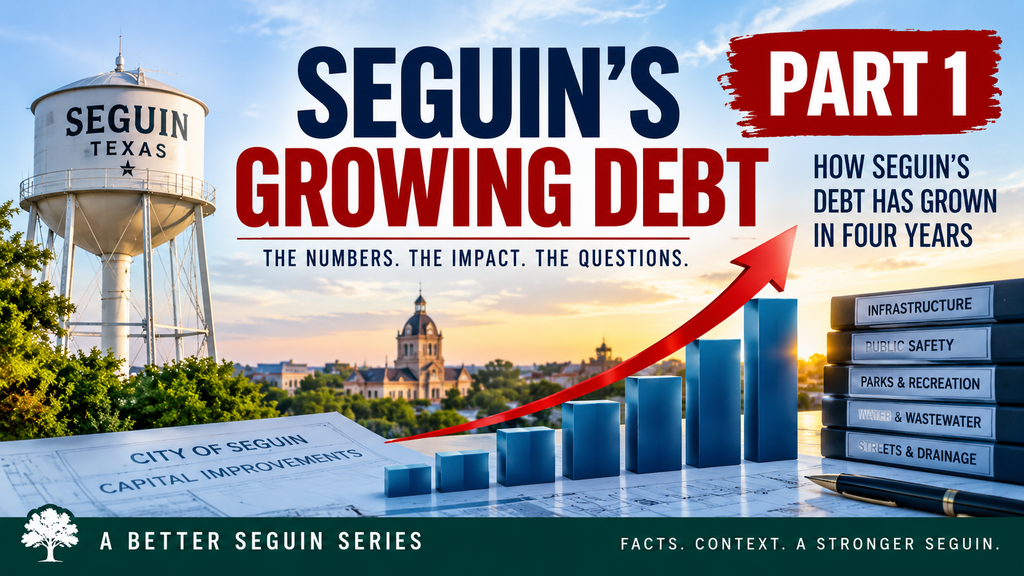
In fiscal year 2021, Seguin reported approximately $156.4 million in outstanding principal debt. By fiscal year 2025, that number had climbed to approximately $666.2 million.
That’s an increase of nearly $510 million — or approximately 326% — in just four years.
The Growth Has Been Significant
Understanding How Debt Has Grown
The City’s annual debt reports show the progression:
| Fiscal Year | Outstanding Principal | Principal + Interest Remaining |
|---|---|---|
| FY2021 | $156.4 million | $213.0 million |
| FY2022 | $169.7 million | $235.0 million |
| FY2023 | $428.5 million | $686.6 million |
| FY2024 | $530.7 million | $909.5 million |
| FY2025 | $666.2 million | $1.229 billion |
The largest jump occurred between FY2022 and FY2023, when outstanding principal increased by approximately $259 million.
Borrowing continued after that. Outstanding principal increased another approximately $102 million in FY2024 and approximately $135 million in FY2025.
These are substantial changes for a city Seguin’s size.
More Than $1.2 Billion in Future Payments
Principal tells only part of the story.
The City’s FY2025 debt report shows approximately $666.2 million in outstanding principal, but the combined principal and interest required to pay all outstanding obligations on schedule totals approximately:
$1.229 billion.
The difference is approximately $562.4 million in future interest over the remaining life of the obligations.
Some individual debt issues demonstrate how significant long-term financing costs can become.
The City’s 2025 Certificates of Obligation, for example, show approximately $144.6 million in outstanding principal and approximately $348.0 million in scheduled principal and interest through final maturity.
That represents roughly $203.4 million above the outstanding principal amount over the remaining life of that issue.
Similarly, the City’s 2024 Certificates of Obligation show approximately $109.2 million in outstanding principal and approximately $239.0 million in remaining principal and interest — a difference of about $129.8 million.
Those numbers can be startling, but they need some important context.

Not All of This Debt Is Paid Through Property Taxes
It would be misleading to suggest that Seguin property taxpayers are directly responsible for paying the entire $666 million through their property-tax bills.
They aren’t.
Seguin’s debt includes both tax-supported obligations and substantial utility-system debt.
According to the FY2025 report, approximately $160.1 million in outstanding principal is identified as debt secured by ad valorem taxation. The combined principal and interest required to pay those tax-secured obligations is approximately $266.4 million.
A substantial portion of the remaining debt relates to Seguin’s utility system.
Those obligations are generally supported through utility revenues rather than the City’s property-tax levy.
That distinction matters—but utility debt isn’t free to residents either. Ultimately, the financial health of the utility system and the rates customers pay are important parts of the equation.
What Is Seguin Borrowing For?
The City’s debt reports show that the money isn’t being borrowed for one single project.
Recent Certificates of Obligation authorize spending for a wide range of capital improvements, including:
- water and wastewater infrastructure;
- streets and bridges;
- drainage;
- public safety facilities and equipment;
- parks and recreational facilities;
- public works facilities;
- land and rights-of-way;
- engineering, design and other professional services associated with those projects.
The 2024 Certificates of Obligation alone totaled $110 million and included utility improvements, streets and bridges, public safety facilities, fire equipment, parks, drainage and associated professional services.
The City followed that with approximately $144.6 million in Certificates of Obligation in 2025.
Debt Isn’t Automatically a Bad Thing
The size of these numbers deserves attention, but debt itself isn’t evidence of poor financial management.
Growing cities frequently finance long-lived infrastructure rather than requiring today’s residents to pay the entire construction cost immediately.
There is a reasonable argument for doing so.
A wastewater treatment plant, major roadway or fire station may serve Seguin residents for decades. Long-term financing spreads some of that cost across the years during which the infrastructure will actually be used.
Seguin also continues to maintain strong credit ratings on many of its rated obligations, according to the City’s debt reports.
The question, therefore, isn’t simply whether Seguin should have debt.
It is how much debt is appropriate, how quickly it should be issued and what taxpayers and utility customers are receiving in return.
Large Amounts of Borrowed Money Have Remained Unspent
Another number deserves attention.
The City’s debt reports show that substantial portions of some recent bond proceeds remained unspent at the time of reporting.
For example, Seguin’s FY2024 report showed approximately $106.6 million of the $110 million 2024 Certificates of Obligation proceeds still unspent.
By the FY2025 report, approximately $71.9 million remained unspent from that issue.
The FY2025 report also showed approximately $144.1 million remaining unspent from the approximately $144.6 million 2025 Certificates of Obligation at that reporting point.
That doesn’t mean the money is sitting idle.
City investment reports show Seguin invests substantial cash balances, including bond proceeds, until the money is needed for projects.
But it raises an important question:
How far in advance of actual construction should the City borrow?
Borrowing early can ensure that money is available when projects are ready. It may also allow the City to move engineering, design and other preliminary work forward so projects can proceed more quickly.
On the other hand, borrowing money long before it is spent can create a financial carrying cost if the interest being paid on the debt exceeds what the City earns investing the unused proceeds.
We don’t yet have enough information to determine which is occurring.
The Question Isn’t Simply “Is $666 Million Too Much?”
That would oversimplify the issue.
Seguin’s population and tax base are growing. The City’s utility system is expanding. Major infrastructure projects are underway, and some investments may position Seguin to obtain state or federal funding that reduces the ultimate local cost.
The more useful questions are:
Why has Seguin’s debt increased so quickly?
How much of the borrowing is necessary to accommodate growth?
How much outside funding is the City able to leverage because projects are designed and ready for construction?
How much borrowed money is sitting invested while awaiting expenditure?
Is Seguin earning enough on those investments to offset the cost of borrowing early?
And perhaps most importantly:
What will today’s borrowing mean for property taxpayers and utility customers over the next 20 to 30 years?
Those are questions Better Seguin believes deserve closer examination.
What’s Next
This is the first in a Better Seguin series examining the City’s growing debt.
In Part Two, we’ll look at what may be driving Seguin’s aggressive capital financing strategy—including rapid growth, infrastructure needs and the increasing importance of having projects designed and ready to compete for outside transportation and infrastructure funding.
Then we’ll look at the financial side: what Seguin pays to borrow money versus what it earns investing unspent bond proceeds, and whether taxpayers are getting a good return from the strategy.
The numbers show that Seguin has made an extraordinary financial commitment to infrastructure in just a few years.
Whether that represents smart investment in a rapidly growing city or a debt burden that is growing too quickly cannot be answered by the $666 million figure alone.
That’s the question we’ll continue examining.