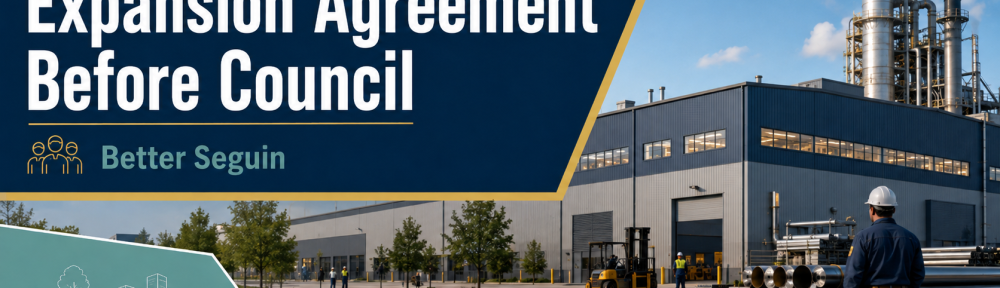
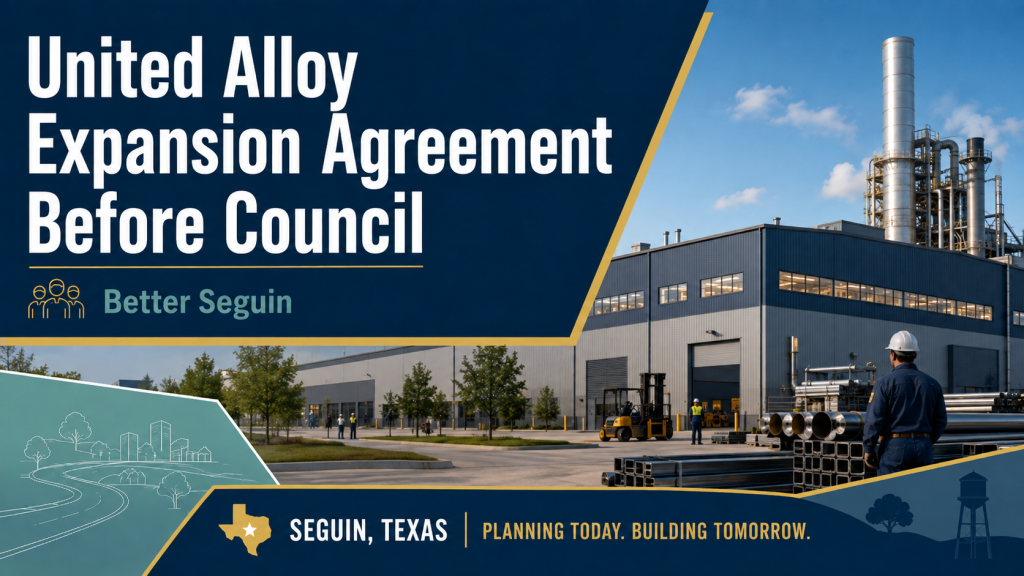
Another economic-development agreement will come before the Seguin City Council Tuesday as Councilmembers consider a performance agreement involving the Seguin Economic Development Corporation, VME LLC and United Alloy Texas LLC.
United Alloy is not new to Seguin.
The company previously entered into an economic-development agreement connected with establishment and expansion of its Seguin operations.
The new agreement provides another opportunity to examine an important question facing growing cities:
What should taxpayers expect in return when public resources are used to encourage private investment?
Seguin Has Previously Invested in United Alloy’s Growth
Under an earlier agreement, the Seguin Economic Development Corporation transferred approximately 27.28 acres of property to the company at no cost.
The agreement placed a value of approximately $859,320 on that property.
In return, United Alloy committed to investment, employment and payroll requirements associated with its Seguin facility.
The earlier agreement was later amended after the company indicated that COVID-era conditions affected the original timetable for later phases of construction. The amended agreement maintained commitments involving overall capital investment, employment and payroll while revising certain construction deadlines.

This history is important context as Council considers another performance agreement.
Economic Development Can Benefit the Community
Economic-development incentives are not inherently good or bad.
When structured properly, they can help a city compete for employers that create jobs, increase the tax base and strengthen the local economy.
Manufacturing and industrial employers can be particularly valuable because they often generate substantial taxable investment without creating the same service demands as large residential developments.
Successful industrial development can also help diversify Seguin’s economy. But incentives should always be tied to measurable performance.
The Public Should Know What Is Being Promised
Whenever an economic-development agreement comes before Council, several questions should be answered clearly:
What is the company investing?
How many jobs will be created or retained?
What payroll or wage commitments are included?
What public incentive is being provided?
How long does the company have to meet its obligations?
What happens if those commitments are not met?
Performance agreements frequently include clawbacks or other protections allowing a public entity to recover incentives when agreed-upon requirements are not fulfilled.
Those protections are important.
An incentive should operate as an investment by the community — not simply as a giveaway.
Measuring Success Matters
The true measure of an economic-development agreement comes years after the ribbon cutting.
Did the promised facility get built?
Did the promised investment occur?
Were the jobs created?
Did those jobs remain?
Did the increased tax base and economic activity justify the public investment?
Those are the standards by which incentive agreements should ultimately be evaluated.
Better Seguin Supports Accountability
Better Seguin wants Seguin to remain competitive in attracting quality employers.
A strong industrial and commercial base can help provide jobs and generate revenue that supports police, fire, streets, parks, utilities and other essential services.
But economic development should also be transparent and measurable.
When public resources are involved, residents deserve to understand both sides of the agreement — what Seguin is providing and what Seguin is receiving in return.
The United Alloy agreement is scheduled for consideration during the August 4 Seguin City Council meeting beginning at 5:30 p.m.