
Seguin Council to Consider 1,323-Home Canvas Development and Up to $95 Million in PID Bonds
July 19, 2026
Story by Better Seguin
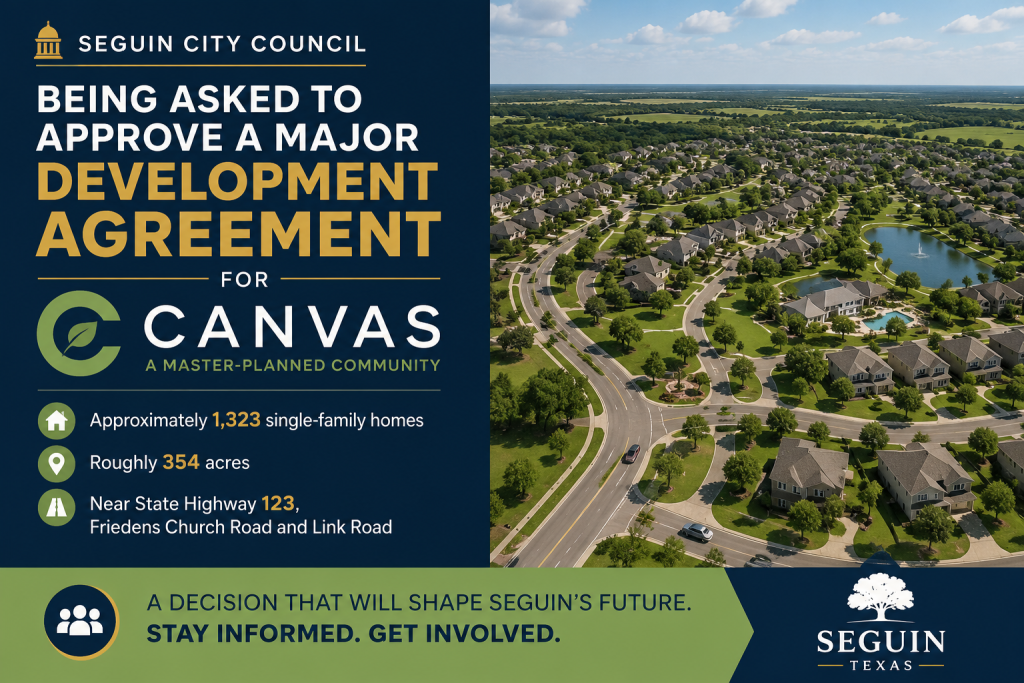
The Seguin City Council is being asked to approve a major development agreement for Canvas, a proposed master-planned community of approximately 1,323 single-family homes on roughly 354 acres near State Highway 123, Friedens Church Road and Link Road.
The development would include several housing types, neighborhood commercial space, public trails, parks, open space and major water, wastewater, roadway and drainage improvements. The agreement also establishes the framework for annexing portions of the property into Seguin and creating a Public Improvement District, or PID, and a Tax Increment Reinvestment Zone, commonly called a TIRZ.
Residents can follow this item and other upcoming municipal decisions through Better Seguin’s City Council Schedule or review meeting agendas and supporting documents through the City’s official meeting calendar.
What Is Being Proposed?
Canvas would be developed by subsidiaries of Red Oak Development Group and would encompass approximately 354 acres. About 80 acres are already inside Seguin, while the remaining property is within the city’s extraterritorial jurisdiction and would be annexed as different phases are prepared for development.
The project is expected to include:
- Approximately 1,323 single-family homes
- At least 10,000 square feet of commercial or retail space
- Approximately two miles of public trail
- A future 12-foot-wide regional shared-use path
- Neighborhood parks and open spaces
- Amenity centers and recreational facilities
- New streets, water lines, wastewater facilities and drainage improvements
The development agreement would remain in effect for 15 years. During that time, its terms would generally control when they directly conflict with later City development regulations, to the extent permitted by law.

Parks, Trails and Community Amenities
The project’s parks and trails plan identifies approximately 107 acres of parks, open space, amenity areas, detention ponds and drainage areas. However, about 37.7 acres of that total consist of detention or drainage-conveyance property, meaning the amount of traditional, usable park and open space is smaller than the headline figure may suggest.
The developer would be required to contribute at least $3 million toward public park improvements before the Phase 3 final plat is recorded. The agreement calls for approximately two miles of trail and requires the developer to select at least one major destination amenity, such as:
- A splash pad
- A large inclusive playscape
- A large public pavilion
The developer must also provide at least one supporting amenity, such as pickleball courts, additional trails, an outdoor fitness area, a bicycle skills course or a smaller pavilion.
These amenities would provide real value to residents. However, the City and developer should clearly explain which parks and trails will be maintained by the homeowners association and which will eventually become a City maintenance responsibility.
How the PID Would Work
A PID allows public infrastructure to be financed through special assessments placed on property within the development. These assessments are separate from ordinary property taxes and become liens against the individual properties.
Under the proposed agreement, assessments could remain in place for as long as 30 years. Future buyers would be required to receive disclosures explaining the PID assessment before purchasing a home.
The agreement permits a maximum PID assessment equivalent to $1.304 per $100 of estimated property value. The agreement expressly acknowledges that this exceeds the $0.55 maximum contained in the City’s current PID policy.
For perspective, an equivalent rate of $1.304 per $100 represents:
| Estimated home value | Maximum equivalent annual assessment |
|---|---|
| $250,000 | $3,260 |
| $300,000 | $3,912 |
| $350,000 | $4,564 |
| $400,000 | $5,216 |
These figures illustrate the gross equivalent assessment before any applicable TIRZ credit and do not necessarily represent the final payment for a particular home.
The City could eventually authorize multiple series of PID bonds with a combined principal amount of up to $95 million. The bonds could be used for infrastructure, financing costs, reserves, administrative expenses and limited capitalized interest.
Approval of the development agreement does not automatically issue the bonds. Future bond issuances would remain subject to additional City Council action, market conditions and financial review.
How the TIRZ Would Reduce the Homeowner’s Payment
The proposed TIRZ would capture 50% of the City property-tax increment generated within the project. The City would also seek participation from Guadalupe County.
That tax increment would be used first for administration and then to reduce the annual PID assessment charged to individual properties. In practical terms, the structure works like this:
Gross PID assessment
minus TIRZ credit
equals the homeowner’s net annual PID payment
This may make the annual payment more affordable to homeowners, but it does not eliminate the underlying assessment or lien. It also means that a portion of the new property-tax revenue generated by Canvas would be redirected toward project financing rather than becoming available for the City’s general operations.
The Council memo describes this arrangement as a way to “pay down” the PID and keep the project’s overall tax burden within an acceptable range.
Residents can review Seguin’s general property-tax information through the City’s Tax Rate Information page.
Why Begin With Such a High PID?
The higher PID assessment provides security for the bonds and ensures that sufficient revenue is legally available if the development does not grow as quickly as projected or if the anticipated TIRZ revenue falls short.
The TIRZ credit is dependent upon homes being built, property values reaching projected levels and tax revenue actually being collected. Bondholders may therefore want the full PID assessment available, even when the expectation is that future tax revenue will reduce what homeowners pay each year.
However, this raises an important public-policy question:
Why not issue fewer PID bonds and establish a lower assessment from the beginning?
A lower PID could require the developer to provide more private capital, finance more infrastructure directly, defer reimbursement or reduce the amount of infrastructure financed through public mechanisms.
Better Seguin feels the City should require a clear comparison showing how much lower the PID assessment could be if the developer financed a greater portion of the project itself.
Estimated Infrastructure Costs
The development agreement estimates approximately $87.5 million in improvements:
| Improvement category | Estimated cost |
|---|---|
| Major off-site and regional improvements | $11.9 million |
| Direct public improvements | $51.8 million |
| Private improvements | $23.8 million |
| Total | $87.5 million |
The developer would initially construct much of the infrastructure. Eligible public improvements could later be reimbursed through PID bond proceeds, assessments or TIRZ revenues.
The developer would also receive compensation of at least 4% of eligible hard construction costs when it performs construction oversight for authorized improvements.
The City’s Financial Commitments
The agreement includes several commitments by the City of Seguin.
The City plans to construct:
- An off-site 12-inch waterline loop along SH 123 and Link Road
- An off-site 24-inch wastewater trunk line between the development and the Cordova Lift Station
Both projects are currently anticipated to be completed in 2027.
The City would also agree to:
- Maintain accepted public roads and wastewater infrastructure
- Maintain certain public trails and improvements
- Contribute 50% of eligible incremental City property-tax revenue to the TIRZ
- Consider using eminent domain for necessary off-site easements when voluntary acquisition is unsuccessful
- Reimburse eligible public infrastructure costs through PID or TIRZ financing
The developer would be responsible for the costs of any eminent-domain proceedings requested for the project, although qualifying costs could later be reimbursed through PID assessments.
Developer Commitments
The developer’s obligations include:
- Constructing internal roads, utilities and drainage facilities
- Paying approximately $1.52 million toward expansion of the Navarro Lift Station
- Extending water and wastewater lines across Link Road
- Constructing traffic improvements required by the project’s traffic study
- Contributing up to $400,000 toward a teacher-housing initiative
- Constructing at least 10,000 square feet of commercial or retail space
- Dedicating right-of-way for the future Outer Loop and Geronimo Creek bridge project
- Establishing a mandatory homeowners association
- Providing two-year maintenance bonds for public infrastructure
- Indemnifying the City against certain construction-related claims
The homeowners association would maintain private amenities, common landscaping, detention ponds, screening walls, entrance features, parking areas and other improvements not accepted for City maintenance.
The City Is Waiving a Significant Fee
Seguin’s PID policy normally provides for a Community Benefit Fee equal to 10% of net PID bond proceeds. The proposed agreement waives that fee in recognition of the parks, trails and other amenities being included in Canvas.
Because the agreement allows as much as $95 million in PID bonds, the potential value of the waiver could be substantial. The actual amount would depend upon the bonds ultimately issued and the net proceeds produced.
Better Seguin feels the Council should receive a dollar-for-dollar comparison showing:
- The estimated value of the waived fee
- The actual cost of the public amenities
- Which amenities the City will maintain
- Which amenities the HOA will maintain
- Whether those benefits justify the full waiver
Questions That Should Be Answered
Canvas could bring new housing, commercial activity, trails, parks and infrastructure to Seguin. The project may produce a positive long-term result, but its financing is complicated and will affect future homeowners and City taxpayers for many years.
Before moving forward, Better Seguin feels residents and Council members should receive clear answers to several questions:
- What would the annual PID payment be on a typical Canvas home before and after the TIRZ credit?
- How much City property-tax revenue will be redirected over the life of the TIRZ?
- How much lower could the PID be if the developer contributed more private financing?
- What is the estimated dollar value of the waived Community Benefit Fee?
- What infrastructure and park-maintenance expenses will eventually become City responsibilities?
- What happens to homeowner payments if projected property values or TIRZ revenues fall short?
- How much net annual revenue will remain available for police, fire, streets and other City services?
- Why does the agreement allow an assessment substantially above the limit in the City’s current PID policy?
How Residents Can Participate
Residents should review the supporting documents, follow the Council agenda and communicate their questions to elected officials before final financial commitments are approved.
You can:
- Review Better Seguin’s City Council Schedule
- Find and contact your City Council member
- View the City’s official City Council page
- Learn how to provide public comment at City Hall
- Contact Better Seguin with questions or information
- Sign up for Better Seguin updates
Responsible growth requires more than approving new homes. It requires careful planning, understandable financing, protection for future homeowners and an honest accounting of the long-term costs and benefits to the entire community.
The City Council resolution would approve the development agreement and authorize the City Manager to execute it and associated documents. The staff memo states that formal PID and TIRZ actions would return to the Council at a future date.